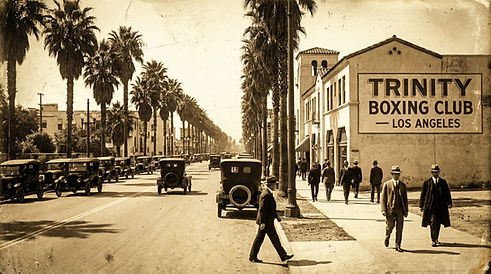
The philosophy & the theology of boxing · the science of striking · the art of self defense — one gym, one story, one good fight.
Fig. 1 — The gymnasium. Where instincts are made, not found.
Fight the Good FightThe Creed · Why This Gym Exists
Nobody walks into this gym by accident. You were always a fighter — we just remind you how to do it. Every struggle, every challenge, every opponent you face in life, we're always in your corner. That's not a slogan. That's the whole operation.
Trinity is built on three things, and they're all the same thing. The philosophy and theology of boxing — because a man who doesn't believe in anything will fall for everything, and a fight without a reason is just violence. The science of striking — because belief without competence is a prayer with no legs. And the art of self defense — because the whole point of learning to fight is so you don't have to.
Put them together and you get the oldest deal in the book: have a belief, and be able to fight for it. That's the Hero's Journey. That's the American Dream. That's your grandfather getting off the boat with nothing, and that's you walking up the gym stairs on a Tuesday night when you'd rather be on the couch.
Boxing isn't fighting. One is a sport, the other is an instinct. We take behaviors and turn them into habits, then we take those habits and turn them into new instincts. The ring doesn't just build fighters. It builds whole men — and whole women. The rest of your life is the title fight. This is the training camp.
"All men are created equal — they're just not born that way. Boxing levels the playing field."
Tonight's Card · Three Bouts, One Fight
Everything under this roof falls under one of three headings. Master all three and you're not just a boxer — you're dangerous in the way good men are supposed to be.
Why you fight. Faith, fear, and the good fight itself. Fear is the great motivator — fight, flight, freeze or faint. Pick one, then train for it. We hold the first kind sacred.
How you fight. Stance, leverage, the kinetic chain from the ball of the foot to the last knuckle. A punch is physics with a purpose — and physics doesn't care how big you are.
When you fight — which is almost never. The sweet science is the art of not being there when trouble arrives, and ending it fast when it insists. Learn to fight so you don't have to.
"I have fought the good fight, I have finished the race, I have kept the faith."
The motto over our door isn't decoration. Fight the good fight is scripture, and it's also a set of instructions. Note it doesn't say win the good fight. It says fight it. Keep the faith, finish the race, answer the bell. The outcome belongs to God; the effort belongs to you. That division of labor has kept Irish Catholics sane for centuries.
Here's the theology of boxing in one question: what's your biggest fear going into a ring? Most people think it's getting hit. It isn't. It's hitting someone else. The first time you sit with that, you understand why boxing is a moral education and not a workout. You're not learning violence — you're learning what you're carrying, and how to aim it at something worthy.
Fear is the great motivator. Fight, flight, freeze or faint — pick one, then train for it. The hero and the coward feel exactly the same fear; the hero uses it, the coward runs from it. Courage isn't the absence of fear. It's fear that said its prayers.
And when the last bell of the week rings, the schedule says what it has always said:
Taught the old way — the professional boxer's regimen, plate by plate, like the instruction manuals your grandfather learned from. No aerobics with gloves on. The real curriculum.
Feet under your convictions. Balance before power, always.
The truth-teller. It measures, it interrupts, it sets up everything.
The whole body in one straight line — hip, shoulder, fist, purpose.
Short, close, honest. Thrown with the legs, not the arm.
Angles beat anger. Position is nine-tenths of the fight.
Ground → hip → torso → shoulder → knuckle. Physics doesn't care how big you are.
Here's the science part nobody tells you: power doesn't come from muscle, it comes from sequence. The punch starts in the floor. Force travels up the leg, turns through the hip, whips across the torso, and arrives at two knuckles moving in a straight line. Get the sequence right and a 140-pound accountant hits harder than a 220-pound guy who's all shoulders. That's why we say brains over brawn — the ring is the one place in America where the math is honest.
One Gym · Five Ways In · Every Level
One-on-one with a Trinity coach. Your stance, your pace, your fight plan. The fastest way to learn the science.
The gym floor, the heavy bags, the crew. Real boxing technique in a group setting. No choreography. No nonsense.
Ages 7–15. Discipline, confidence, and courage. We teach kids to be brave — not to be bullies. Be Famous On Your Block.
Team building with teeth. Bring your office, your squad, your crew. We'll put them through the ropes together.
They used to call boxing the sweet science of self defense, and both halves of that phrase matter. Sweet, because there is a real elegance in slipping a punch by two inches instead of two feet. Science, because none of it is guesswork. And self defense, because the entire moral license for knowing how to hurt somebody is that you're the one who decides not to.
Here's what we actually teach: distance, timing, and composure under pressure. The man who panics loses before anything lands. So we put you under controlled pressure, round after round, until the alarm bells in your head learn some manners. What used to trigger flight or freeze becomes information. You see the punch coming and your feet already answered it.
That's the art. Not the highlight-reel knockout — the quiet confidence of a person who knows exactly what they can handle. It changes how you stand on a subway platform. It changes how you sit in a salary negotiation. Trouble reads posture like a bouncer reads a fake ID, and yours stops lying.
Boxing isn't fighting. One is a sport, the other is an instinct.
The best defense is to not be there. The second best is to make them regret you were.
We take behaviors and turn them into habits. Then we take habits and turn them into new instincts.
Walk like you know where you're going, and most trouble will pick somebody else.
Joseph Campbell mapped the same story every civilization tells — the call, the trial, the return. We just happen to run the whole curriculum in twelve rounds, with a bell.
"Everybody has two identities — the one you're born with and the one you live with. Who you are is not who you were."
Every Fighter Has a Ring Name. What's Yours?
The couch. The commute. The feeling something's missing.
Somebody says "you should try boxing." The door appears.
"I'm not a fighter." Fear talks you out of it. Twice.
The trainer. The corner man. The one who sees what you can't.
You walk through the door. First day. First round. First sweat.
Sore hands, bruised ego, the mirror that doesn't lie.
Sparring. The first time someone tries to hit you back.
The round you wanted to quit and didn't. The death of the old self.
Confidence. Composure. The posture of someone who knows.
Taking what you learned in the ring back into the world.
The new you. Tested. Proven. Different than before.
You bring it home. To your family, your work, your life.
It is Your Story and it is My Story. The details change — the journey doesn't. Boxing gets you ready for it.
The American Dream isn't a house with a lawn. It's the wager an immigrant makes at the rail of a steamship: give me a fair fight and I'll take my chances. That's all anybody in this family ever asked for. Boxing was the first American institution that paid off on that promise — the ring doesn't check your accent, your parish, or your father's bank balance. It checks your chin and your heart, in that order.
That's why we say boxing levels the playing field. Every wave that came through this harbor — Irish, Italian, Jewish, Black, Puerto Rican, Dominican — sent its kids up the same gym stairs to collect the same inheritance: proof that where you start is not where you finish.
Lorenzo Snow, twelfth son of a Limerick potato farmer, sails for America with nothing but a right hand and a catechism.
Prizefights his way to 168–2 with 156 knockouts. Marries Maggie McEldowney — vaudeville star and professional boxer. Their firstborn: Trinity.
The Trinity Club opens in Five Points — a boxing speakeasy where champions, writers, and a future president learned to slip and counter.
The club goes dark with the Crash. The family keeps the faith and the name.
Revived in New York, 1997. West Coast chapter, 2007. Three gyms in the family. Same fight.
Carl Jung never laced a glove and Cus D'Amato never read a word of analytic psychology — and they arrived at the same map. The shadow you refuse to face fights dirty from the dark; the fear you befriend becomes fire. A century apart, a Swiss doctor and a Bronx trainer both concluded that the fight is inward first. We built a whole study on it.
"Everyone carries a shadow."
"The hero and the coward feel exactly the same fear."
"Who looks outside, dreams; who looks inside, awakes."
"I don't make fighters. I make men. The boxing is just the means."
"The persona is a mask that pretends individuality."
"Every fighter has a ring name. It's the truer one."
Same philosophy. Same standards. Same corner. The only difference is the area code.
20 Vesey St · (212) 374-9393 · nyc@trinityboxing.com
Classes Mon–Fri 7am, noon, 5pm & 6pm · Sat 9am & 10am. Doors Mon–Fri 6am–8pm, Sat 8am–3pm. Sunday: Go To Church.
Book your trial round — $30 →7817 Melrose Ave (alley entrance) · (323) 371-3444
Youth classes Mon–Thu 4–5pm. Grown-ups: daily group sessions — the West Coast chapter of the same old-country corner. info@trinityboxingla.com.
Book your trial round — $30 →Everybody has two identities — the one you're born with and the one you live with. Every fighter has a ring name. Come find out what yours is.
Trinity is a corner, not a building. These are the other rooms in the same house — each one a different door into the same fight.
One corner. Many fighters. The same good fight.